Doris Sommer the Work of Art in the World
 Celebrating art and estimation that take on social challenges, Doris Sommer looks to steer the humanities dorsum to appointment with the earth. Among the cases that she covers are meridian-downward initiatives of political leaders, such as those launched by Antanas Mockus, quondam mayor of Bogotá, Colombia, and also bottom-up movements like the Theatre of the Oppressed created by the Brazilian director, author, and educator Augusto Boal. This inspiring book is filled with models, sources, and ideas that tin exist adapted and adopted to inform teaching and inquiry most activist art and creativity, findsAnna Upchurch.

T he Work of Art in the World: Civic Agency and Public Humanities. Doris Sommer. Duke University Press. February 2014.
Observe this book:

Contempo years have seen a number of new books published past senior academics responding to the current budget-cutting tensions that arts and humanities disciplines face in higher educational activity, caused by economic recessions in Western Europe and the United States. Notable examples include Not for Profit: Why Democracy Needs the Humanities by Martha C. Nussbaum (2010), The Humanities and the Dream of America past Geoffrey Galt Harpham (2011), Blow Up the Humanities by Toby Miller (2012), and The Value of the Humanities by Helen Small (2013). Stefan Collini's What are Universities For? (2012) answers the big question expressed in its provocative title and includes a chapter, 'The Character of the Humanities'. While each makes a distinctive contribution to the current argue, broadly speaking these books historicize and re-land arguments about the value of arts and humanities subjects, enquiry, and instruction to contemporary societies.
Doris Sommer'south The Piece of work of Art in the World: Civic Agency and the Public Humanities is a fresh and welcome improver that explores projects from the programme she founded at Harvard University, the Cultural Agents Initiative, within the context of socially engaged fine art and interpretation. Sommer is Professor of Romance Languages and Literatures and of African and African American Studies at Harvard and also author of Bilingual Aesthetics: A New Sentimental Education. Established in 2000, the Cultural Agents Initiative 'has sought to increase the impact of artistic and scholarly practices by identifying artists, educators, and community leaders who accept developed socially productive artistic practices, by reflecting on the role of fine art in building ceremonious society, and by disseminating best practices through workshops and public forums'. Sommer recalls in the book'southward introduction that a motivation to start the programme were very real fears about the futurity of the humanities in corporatized universities.
The Work of Art in the World looks back over more a decade of collaboration between artists and academics and 'takes inspiration from arts projects that merit more sustained reflection than they accept gotten. These are creative works on grand and small scales that morph into institutional innovation. Reflecting on them is a humanistic assignment insofar equally the humanities teach interpretation of art (to identify points of view, attend to technique, to context, to competing letters, and evaluate aesthetic furnishings)' (p. 3). This aesthetic training by humanists 'tin fulfil a special mission by keeping aesthetics in focus, lingering with students and readers over the overjoyed moments of freely felt pleasure that enable fresh perceptions and foster new agreements' (p. 3). Drawing upon intellectual sources that include Kant, Schiller, Dewey, and Ranciére, among others, Sommer argues that the artful grooming that fosters individual judgement underpins civic life in democracies. Her concern is not to teach pessimism and retreat from the earth: 'Educational activity despair to young people seemed to me not only deadening but irresponsible compared to making a example for cultural agents' (p. 6). And no doubt her students, similar mine, are far more interested in her risk-taking cultural agents and models of practice that they can analyse, interpret, and potentially accommodate.
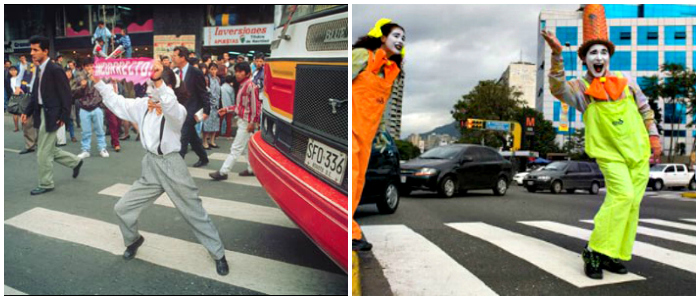
The book opens with two chapters that explore these projects and models. Chapter one, 'From the Top', examines government-sponsored inventiveness in projects as diverse as the troupe of traffic-directing mimes in Bogotá, Colombia, conceived by and then-Mayor Antanas Mockus, to the Piece of work Progress Administration'southward Federal Fine art Projection in the United states from 1935 to 1939 during President Franklin Delano Roosevelt's New Deal. The importance of play and pleasure in changing public attitudes was illustrated by the mimes, who drew attending in fun ways to traffic and pedestrian safety, helping to reduce deaths and accidents. This programme was one of many creative initiatives in the public space in Bogotá that Mockus was invited to Harvard to share in the Cultural Agents programme.
Chapter 2, 'Press Here', concerns 'lesser upward' initiatives past artists and cultural agents who are catalysts and organizers. Sommer recalls the international artistic and political career of Augusto Boal, who adult Forum Theatre and other interactive theatre techniques and games that encouraged 'spect-actors' to explore moral and ethical challenges of everyday life. Like Mockus, Boal was invited to Harvard to lead workshops and teach his techniques to participants and students. The workshops had ripple effects such equally a summer theatre production at the local high school, which led to a Forum Theatre approach to AIDS prevention and treatment for youth in Tanzania, amongst other offshoots. Other change-agent projects include an exhibition about ACT UP, the gay rights entrada in the late 1980s and early 1990s in New York that resulted in lower prices and shorter approving times for AIDS treatments.
Chapter four describes 'Pre-Texts', a programme in Boston, Mass., that integrates literacy, sustainable arts and materials, and civic values, using the arts to teach literacy and literary criticism to immature people ranging in age from kindergarten to graduate studies. Office of the Cultural Agents Initiative, Pre-Texts trains artists and teachers to facilitate workshops at schools, summer programmes, and other settings, inviting young people to interpret classic literary texts through their own art made from recycled materials.
Few of us have access to the resources that Sommer has at Harvard, but this inspiring book is filled with models, sources, and ideas that can exist adjusted and adopted to inform didactics and research about activist fine art and creativity.
—————————————-
Anna Upchurch is Lecturer in Cultural Industries at the University of Leeds. She specializes in cultural policy and the history of ideas nearly the arts and humanities in society. She co-edited Humanities in the Twenty-First Century: Beyond Utility and Markets (2013) with Dr Eleonora Belfiore. Read more reviews by Anna.

Source: https://blogs.lse.ac.uk/lsereviewofbooks/2014/03/21/book-review-the-work-of-art-in-the-world-civic-agency-and-public-humanities-by-doris-sommer/
0 Response to "Doris Sommer the Work of Art in the World"
Post a Comment