What Kind of Volcanic Hazard Can Be Triggered by the Collapse of a Lava Dome?
Home » Volcanoes » Volcanic Hazards
Volcanic Hazards
Many types of hazards are associated with volcanoes
Commodity by Jessica Ball
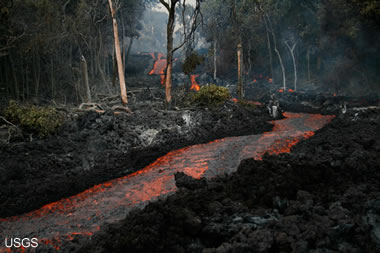
This is 1 of several lava streams of the Prince Artery flow slicing through the woods between the cross streets of Paradise and Orchid. The lava stream is about iii meters (10 feet) wide. (Kalapana/Royal Gardens, Hawaii). Image past USGS. Enlarge Image
Volcanic Hazards
Volcanoes can be exciting and fascinating, just also very dangerous. Whatsoever kind of volcano is capable of creating harmful or deadly phenomena, whether during an eruption or a menstruation of quiescence. Understanding what a volcano tin can do is the first footstep in mitigating volcanic hazards, only it is important to remember that even if scientists have studied a volcano for decades, they do not necessarily know everything it is capable of. Volcanoes are natural systems, and always have some element of unpredictability.
Volcanologists are always working to understand how volcanic hazards carry, and what can be done to avoid them. Hither are a few of the more common hazards, and some of the ways that they are formed and behave. (Delight note that this is intended as a source of basic information only, and should non exist treated as a survival guide past those who live near a volcano. Always mind to the warnings and information issued by your local volcanologists and ceremonious government.)
Table of Contents
Lava Flows
Lava is molten rock that flows out of a volcano or volcanic vent. Depending on its composition and temperature, lava can be very fluid or very sticky (viscous). Fluid flows are hotter and move the fastest; they tin form streams or rivers, or spread out across the landscape in lobes. Gluey flows are cooler and travel shorter distances, and tin can sometimes build up into lava domes or plugs; collapses of period fronts or domes can class pyroclastic density currents (discussed later).
Most lava flows can be hands avoided by a person on foot, since they don't move much faster than walking speed, but a lava flow usually cannot exist stopped or diverted. Because lava flows are extremely hot - betwixt 1,000-2,000°C (one,800 - 3,600° F) - they tin cause severe burns and often burn vegetation and structures. Lava flowing from a vent besides creates enormous amounts of pressure level, which can crush or bury whatsoever survives being burned.
Pyroclastic Density Currents
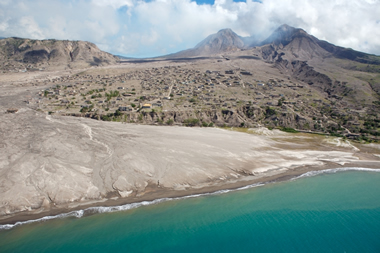
Pyroclastic flow deposits covering the former city of Plymouth on the Caribbean island of Montserrat. Epitome copyright iStockphoto / S. Hannah. Overstate Image
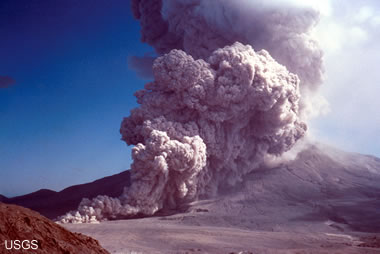
Pyroclastic flow at Mount St. Helens, Washington, August 7, 1980. Image by USGS. Overstate Paradigm
Pyroclastic Density Currents
Pyroclastic density currents are an explosive eruptive phenomenon. They are mixtures of pulverized stone, ash, and hot gases, and can motility at speeds of hundreds of miles per hour. These currents can exist dilute, as in pyroclastic surges, or concentrated, every bit in pyroclastic flows. They are gravity-driven, which means that they menstruum downwards slopes.
A pyroclastic surge is a dilute, turbulent density current that normally forms when magma interacts explosively with water. Surges tin can travel over obstacles like valley walls, and leave sparse deposits of ash and rock that drape over topography. A pyroclastic flow is a concentrated avalanche of textile, oft from a plummet of a lava dome or eruption cavalcade, which creates massive deposits that range in size from ash to boulders. Pyroclastic flows are more probable to follow valleys and other depressions, and their deposits infill this topography. Occasionally, still, the top part of a pyroclastic flow cloud (which is mostly ash) will detach from the menstruation and travel on its own as a surge.
Pyroclastic density currents of any kind are mortiferous. They can travel short distances or hundreds of miles from their source, and motion at speeds of upwardly to 1,000 kph (650 mph). They are extremely hot - upwardly to 400°C (750°F). The speed and forcefulness of a pyroclastic density electric current, combined with its heat, mean that these volcanic phenomena normally destroy anything in their path, either by burning or crushing or both. Anything caught in a pyroclastic density current would be severely burned and pummeled by debris (including remnants of whatsoever the period traveled over). There is no fashion to escape a pyroclastic density current other than not being there when it happens!
Ane unfortunate example of the destruction acquired by pyroclastic density currents is the abandoned city of Plymouth on the Caribbean area island of Montserrat. When the Soufrière Hills volcano began erupting violently in 1996, pyroclastic density currents from eruption clouds and lava dome collapses traveled down valleys in which many people had their homes, and inundated the urban center of Plymouth. That office of the island has since been declared a no-entry zone and evacuated, although it is still possible to see the remains of buildings which have been knocked over and cached, and objects that have been melted by the heat of the pyroclastic density currents.
Ad
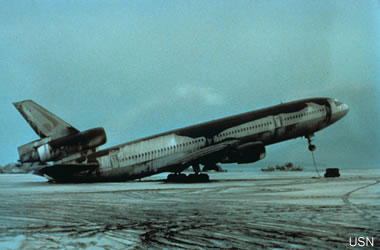
Mountain Pinatubo, Philippines. View of Globe Airways DC-x airplane setting on its tail considering of weight of June 15, 1991 ash. Cubi Bespeak Naval Air Station. USN photograph by R. Fifty. Rieger. June 17, 1991. Enlarge Image
Pyroclastic Falls
Pyroclastic falls, also known as volcanic fallout, occur when tephra - fragmented stone ranging in size from mm to tens of cm (fractions of inches to feet) - is ejected from a volcanic vent during an eruption and falls to the footing some distance away from the vent. Falls are usually associated with Plinian eruptive columns, ash clouds or volcanic plumes. Tephra in pyroclastic fall deposits may accept been transported only a brusk altitude from the vent (a few meters to several km), or, if it is injected into the upper atmosphere, may circle the globe. Any kind of pyroclastic fall deposit will mantle or drape itself over the landscape, and volition decrease in both size and thickness the farther away it is from its source.
Tephra falls are usually non directly unsafe unless a person is shut enough to an eruption to be struck by larger fragments. The effects of falls tin be, all the same. Ash tin can smother vegetation, destroy moving parts in motors and engines (particularly in aircraft), and scratch surfaces. Scoria and small bombs can break delicate objects, dent metals and get embedded in woods. Some pyroclastic falls contain toxic chemicals that tin exist absorbed into plants and local water supplies, which can be dangerous for both people and livestock. The principal danger of pyroclastic falls is their weight: tephra of any size is fabricated up of pulverized rock, and can be extremely heavy, especially if it gets wet. Nearly of the harm caused by falls occurs when wet ash and scoria on the roofs of buildings causes them to collapse.
Pyroclastic textile injected into the atmosphere may have global besides as local consequences. When the volume of an eruption cloud is large plenty, and the cloud is spread far plenty by wind, pyroclastic fabric may actually block sunlight and cause temporary cooling of the World'southward surface. Following the eruption of Mount Tambora in 1815, and so much pyroclastic cloth reached and remained in the Earth'due south atmosphere that global temperatures dropped an average of about 0.v °C (~one.0 °F). This caused worldwide incidences of extreme weather, and led 1816 to be known every bit 'The Year Without A Summertime.'
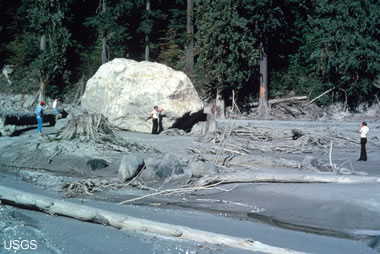
Large boulder carried in lahar flow, Dirty River, eastward of Mountain St. Helens, Washington. Geologists for scale. Photo by Lyn Topinka, USGS. September 16, 1980. Enlarge Image
Lahars
Lahars are a specific kind of mudflow made up of volcanic droppings. They can form in a number of situations: when pocket-size slope collapses get together water on their fashion downward a volcano, through rapid melting of snowfall and ice during an eruption, from heavy rainfall on loose volcanic debris, when a volcano erupts through a crater lake, or when a crater lake drains because of overflow or wall plummet.
Lahars flow like liquids, but because they contain suspended material, they usually have a consistency similar to wet concrete. They flow downhill and volition follow depressions and valleys, but they can spread out if they attain a flat expanse. Lahars can travel at speeds of over 80 kph (50 mph) and reach distances dozens of miles from their source. If they were generated by a volcanic eruption, they may retain enough rut to still be sixty-lxx°C (140-160°F) when they come to rest.
Lahars are not as fast or hot as other volcanic hazards, but they are extremely destructive. They will either bulldoze or bury anything in their path, sometimes in deposits dozens of feet thick. Any cannot get out of a lahar'due south path volition either be swept away or cached. Lahars can, however, be detected in advance by audio-visual (audio) monitors, which gives people time to reach high ground; they can besides sometimes be channeled away from buildings and people by concrete barriers, although information technology is impossible to terminate them completely.
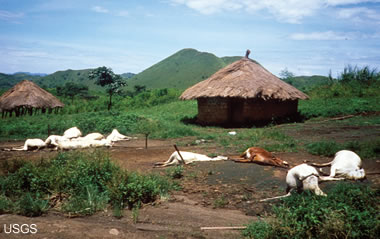
Lake Nyos, Republic of cameroon, Gas Release August 21, 1986. Dead cattle and surrounding compounds in Nyos village. September three, 1986. Image by USGS. Enlarge Image
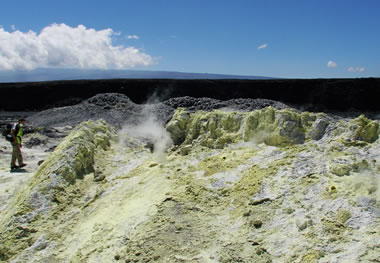
Sulfur dioxide issuing from fumaroles of the Sulfur Banks at the elevation of Kilauea Volcano, Hawaii. Photograph copyright Jessica Ball. Enlarge Epitome
Gases
Volcanic gases are probably the least showy part of a volcanic eruption, but they can be one of an eruption'due south most deadly furnishings. Most of the gas released in an eruption is water vapor (H2O), and relatively harmless, only volcanoes also produce carbon dioxide (CO2), sulfur dioxide (SO2), hydrogen sulfide (H2S), fluorine gas (F2), hydrogen fluoride (HF), and other gases. All of these gases can exist chancy - even deadly - in the right conditions.
Carbon dioxide is not poisonous, but it displaces normal oxygen-bearing air, and is odorless and colorless. Because it is heavier than air, it collects in depressions and can suffocate people and animals who wander into pockets where it has displaced normal air. Information technology can also become dissolved in h2o and collect in lake bottoms; in some situations, the h2o in those lakes can suddenly 'erupt' huge bubbles of carbon dioxide, killing vegetation, livestock and people living nearby. This was the example in the overturn of Lake Nyos in Cameroon, Africa in 1986, where an eruption of COtwo from the lake suffocated more than 1,700 people and 3,500 livestock in nearby villages.
Sulfur dioxide and hydrogen sulfide are both sulfur-based gases, and different carbon dioxide, accept a distinct acidic, rotten-egg smell. Then2 can combine with water vapor in the air to grade sulfuric acid (H2SOiv), a corrosive acid; H2S is also very acidic, and extremely poisonous fifty-fifty in small amounts. Both acids irritate soft tissues (optics, nose, throat, lungs, etc.), and when the gases form acids in large enough quantities, they mix with water vapor to course vog, or volcanic fog, which can be dangerous to breathe and cause harm to the lungs and eyes. If sulfur-based aerosols reach the upper atmosphere, they can cake sunlight and interfere with ozone, which have both short and long-term furnishings on climate.
Ane of the nastiest, although less common gases released by volcanoes is fluorine gas (Fii). This gas is yellowish brown, corrosive and extremely poisonous. Similar CO2, information technology is denser than air and tends to collect in low areas. Its companion acid, hydrogen fluoride (HF), is highly corrosive and toxic, and causes terrible internal burns and attacks calcium in the skeletal system. Fifty-fifty after visible gas or acid has dissipated, fluorine can be absorbed into plants, and may be able to poison people and animals for long periods following an eruption. After the 1783 eruption of Laki in Iceland, fluorine poisoning and famine caused the deaths of more than half the country's livestock and near a quarter of its population.
| Volcanic Hazard Resources |
| Bardintzeff, J.-M. and McBirney, A.R., 2000, Volcanology: Massachusetts, Jones & Bartlett Publishers, 268 p. Schminke, H.-U., 2004, Volcanism: Berlin, Springer, 324 p. McNutt, S.R., Rymer, H., and Stix, J. (editor), 1999, Encyclopedia of Volcanoes: San Diego, CA Bookish Press, 1456 p. Gates, A.E. and Ritchie, D., 2007, Encyclopedia of Earthquakes and Volcanoes, Third Edition: New York, NY, Checkmark Books, 346 p. |
Well-nigh the Author
Jessica Brawl is a graduate pupil in the Department of Geology at the Land University of New York at Buffalo. Her concentration is in volcanology, and she is currently researching lava dome collapses and pyroclastic flows. Jessica earned her Bachelor of Scientific discipline degree from the Higher of William and Mary, and worked for a yr at the American Geological Establish in the Education/Outreach Program. She too writes the Magma Cum Laude blog, and in what spare time she has left, she enjoys rock climbing and playing various stringed instruments.
Detect Other Topics on Geology.com:
 Rocks: Galleries of igneous, sedimentary and metamorphic rock photos with descriptions. |  Minerals: Information about ore minerals, gem materials and rock-forming minerals. |
 Volcanoes: Manufactures nearly volcanoes, volcanic hazards and eruptions by and nowadays. |  Gemstones: Colorful images and articles nigh diamonds and colored stones. |
 General Geology: Manufactures about geysers, maars, deltas, rifts, salt domes, water, and much more! |  Geology Store: Hammers, field bags, mitt lenses, maps, books, hardness picks, gilt pans. |
 |  Diamonds: Larn about the properties of diamond, its many uses, and diamond discoveries. |
Source: https://geology.com/volcanoes/volcanic-hazards/
0 Response to "What Kind of Volcanic Hazard Can Be Triggered by the Collapse of a Lava Dome?"
Post a Comment